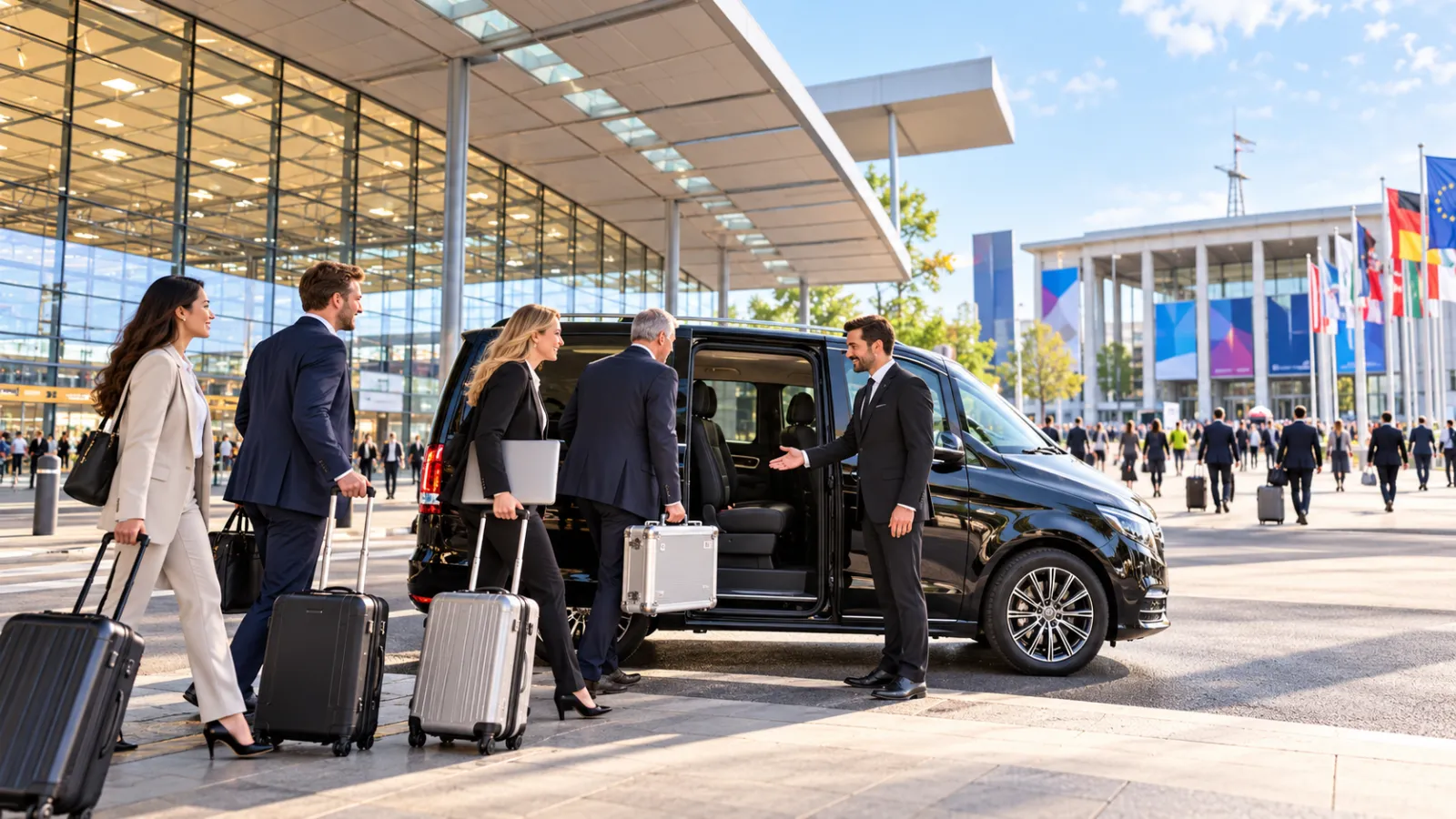
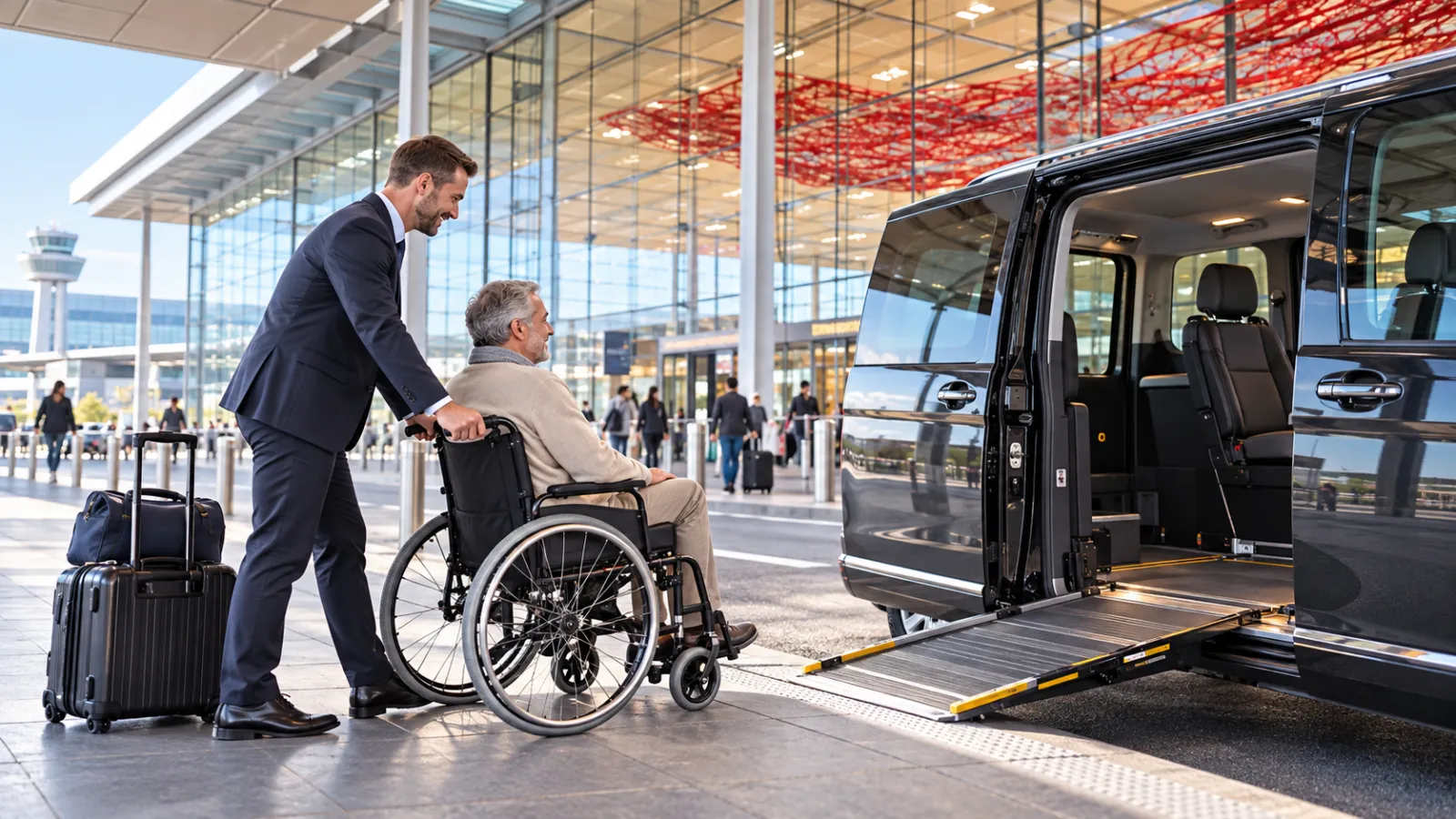
Travelling through a large airport can be challenging for passengers with reduced mobility, older visitors or anyone using a wheelchair. BER Airport provides mobility services, and ground transport can also be planned to reduce unnecessary walking and lifting.
The most important step is to communicate requirements before travel.
Assistance at BER Airport
Passengers who need airport mobility assistance should arrange the relevant service according to airline and airport procedures before the flight.
This assistance can help with movement through check-in, security and boarding or from the aircraft through arrivals.
The airport’s mobility service is separate from the road transport you use after leaving the terminal.
If you need both airport assistance and an adapted vehicle, organise both.
Accessible taxi from the airport
BER Airport states that passengers needing a special taxi, including taxis for people with mobility restrictions, should contact the service staff at the official taxi ranks.
The ranks are located north and south of Terminal 1 on arrivals level E0.
This gives arriving passengers a way to request a suitable taxi after landing.
However, specialist vehicle availability can take time, especially if the requirement is specific.
Why pre-planning matters
Not all wheelchairs are the same.
A folding manual wheelchair may fit into the luggage area of many larger cars. A rigid chair or powered wheelchair can require significantly more space and may need a purpose-built accessible vehicle.
A traveller who can transfer independently into a passenger seat has different needs from someone who must remain seated in the wheelchair during the journey.
These details must be communicated before booking.
Private transfer requirements
AirportTaxi.Berlin offers pre-booked partner transfers, but travellers with accessibility requirements should never assume a standard sedan is suitable.
If you use a booking platform, describe the wheelchair type and whether it folds. Confirm whether the offered vehicle supports your specific transfer needs.
A larger minivan may solve luggage space for a folding wheelchair but is not automatically a wheelchair-accessible vehicle for a passenger remaining in the chair.
If a specialised ramp or lift is required, that must be explicitly confirmed.
Terminal 2 considerations
Terminal 2 does not have its own taxi forecourt.
Passengers using taxi facilities normally follow the connection toward Terminal 1.
For a traveller with reduced mobility, airport assistance and the correct pickup instructions become particularly important.
Do not make an unnecessary walk to the wrong meeting area because of a generic online instruction.
Luggage and mobility equipment
Count mobility equipment as part of the vehicle space requirement.
A wheelchair, walker or mobility aid may occupy as much boot space as a large suitcase.
If two travellers each have large luggage plus a folding wheelchair, a sedan may be unsuitable even though there are enough passenger seats.
State all equipment before the journey.
Older travellers
Reduced mobility does not always mean wheelchair use.
Older visitors may simply find long station walks, stairs and repeated transfers difficult.
For them, a door-to-door taxi or private transfer can be more comfortable than public transport, particularly after a long flight.
The value is not speed but reduced walking and fewer transitions.
Public transport accessibility
Berlin’s public transport system includes extensive accessible infrastructure, but lifts can occasionally be out of service and station routes can be long.
If using the train from BER, check the current accessibility information for every station where you need to change.
A direct FEX journey to Hauptbahnhof may be easier than a multi-change route to a residential neighbourhood.
Hotel accessibility
The transport only solves part of the journey.
Confirm that the hotel entrance, lift and room match your needs.
Some older Berlin buildings have steps or small lifts despite being in central locations.
If the vehicle needs to stop close to an accessible entrance, tell the driver which entrance to use.
Travel with a companion
A companion can help with luggage and communication, but the passenger’s own needs should still be communicated clearly.
If the wheelchair folds, know its approximate dimensions.
If batteries are involved, understand the equipment and airline requirements before flying.
Allow extra time
Passengers receiving airport mobility assistance should follow the airline’s recommended arrival time, which may be earlier than for other travellers.
For the return transfer to BER, choose a pickup time that allows for assistance check-in procedures without rushing.
The key question
Do not ask only “Can I book a wheelchair transfer?”
Explain what the passenger actually needs: folding chair or powered chair, ability to transfer, number of companions, amount of luggage and any ramp or lift requirement.
That gives the provider the information needed to determine whether a suitable service is available.
Plan your BER ground transfer carefully: AirportTaxi.Berlin can be used to request partner transfers, but any mobility equipment and accessibility needs should be declared before booking. For a specialised wheelchair-accessible vehicle, obtain explicit confirmation that the offered service meets the passenger’s requirements.